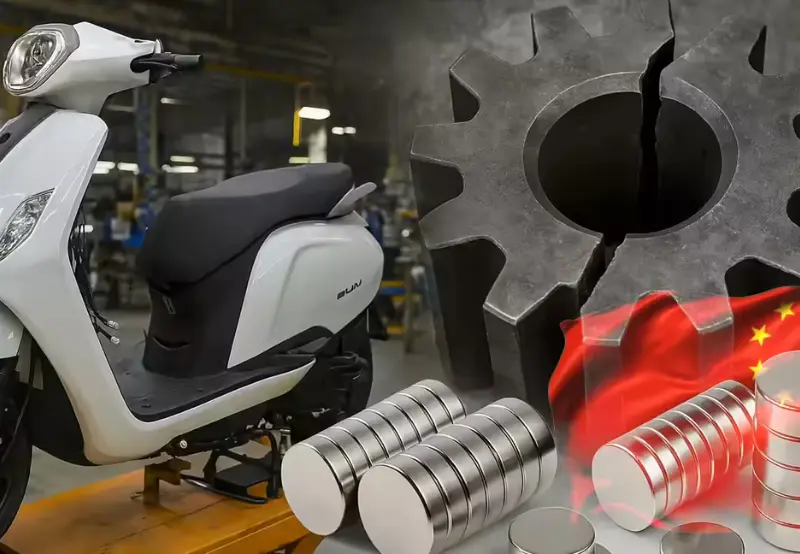

Bajaj Auto faces EV production setback due to rare-earth magnet shortages, impacting 50–60% of Q2 delivery targets. Discover what this means for India’s electric mobility push.
Table of Contents
- Introduction
- Why Rare-Earth Magnets Matter in EVs
- Bajaj Auto’s Announcement: A Closer Look
- Global Rare-Earth Magnet Shortage: Root Causes
- How This Affects India’s EV Roadmap
- Competitor Response & Market Reaction
- Supply Chain Vulnerabilities in EV Manufacturing
- Policy & Import Reliance in India
- What Can Bajaj Auto Do Next?
- Conclusion
1. Introduction
Bajaj Auto faces EV production setback—a worrying sign for India’s booming electric vehicle sector. The company recently disclosed that it will only fulfil 50–60% of its Q2 electric scooter delivery targets. The reason? A global rare-earth magnet shortage—a critical component in EV motors.
This bottleneck has shaken investor confidence and triggered fresh debate around India’s EV supply chain reliance on imports.
2. Why Rare-Earth Magnets Matter in EVs
Rare-earth magnets are small, but their role in electric vehicles is massive. They’re used in:
- Permanent magnet motors, which drive most e-scooters
- Battery management systems
- Regenerative braking units
Key rare-earth elements include:
- Neodymium
- Dysprosium
- Terbium
These magnets are prized for their strength, efficiency, and light weight—making them essential in delivering EV performance.
3. Bajaj Auto’s Announcement: A Closer Look
In early August 2025, Bajaj Auto officially confirmed that their electric scooter production targets for Q2 will fall short by 40–50%.
“We are facing severe raw material constraints, particularly rare-earth magnets. Our supply partners are unable to meet the contracted volume,” said a senior executive from Bajaj Auto.
Models likely to be affected include:
- Bajaj Chetak Urban
- Bajaj Chetak Premium
- Chetak Urbane+
4. Global Rare-Earth Magnet Shortage: Root Causes
This is not an isolated issue. The global shortage stems from:
- Export limitations from China (which controls ~80% of rare-earth processing)
- Rising geopolitical tensions over trade routes
- Limited global refining infrastructure
- Sudden demand spike from EV, wind, and defence sectors
A recent Reuters report confirmed that delays are being felt worldwide, particularly in Asia and Europe.
5. How This Affects India’s EV Roadmap
India’s ambitious goal of 30% EV penetration by 2030 could face a dent if similar shortages continue.
The impact includes:
- Slower rollout of electric two-wheelers
- Delays in meeting FAME-II targets
- Increased pressure on domestic manufacturers
- Drop in consumer confidence and EV sales momentum
6. Competitor Response & Market Reaction
While Bajaj struggles, other players are adjusting:
- Ola Electric has diversified suppliers and localised component sourcing
- TVS Motor is reportedly stockpiling rare-earths
- Ather Energy is exploring alternate motor technologies
Market analysts expect temporary stock slumps for Bajaj but potential gains for competitors who’ve insulated their supply chains.
7. Supply Chain Vulnerabilities in EV Manufacturing
The situation has exposed the fragility of India’s EV supply chain, which heavily depends on imports for:
- Rare-earth magnets
- Lithium-ion cells
- Battery-grade graphite
- Electronic controllers
With limited domestic mining or refining, India remains vulnerable to price shocks and supply disruptions
🇮🇳 8. Policy & Import Reliance in India
Although the Indian government has launched initiatives like:
- PLI for Advanced Chemistry Cells
- Mines & Minerals reforms
- National Rare Earth Mission (proposed)
Most of these are long-term in nature and can’t immediately fix current shortages. Bajaj Auto’s situation underscores the urgency for rapid domestic capacity building.
9. What Can Bajaj Auto Do Next?
To recover from the current EV production setback, Bajaj Auto may:
- Seek alternate suppliers in Japan, Vietnam, or Australia
- Experiment with induction motor designs (magnet-free alternatives)
- Collaborate with ISRO/DRDO on material innovation
- Push for local rare-earth refining projects
Additionally, better supplier diversification contracts can shield from future disruptions.
10. Conclusion
The headline “Bajaj Auto Faces EV Production Setback” reflects more than a single company’s struggle—it’s a systemic challenge in India’s clean mobility mission.
With growing pressure to localise, innovate, and diversify supply chains, this event could serve as a turning point—forcing the industry to become more self-reliant.
India’s EV dream is still alive, but this rare-earth reality check demands immediate action and long-term planning.