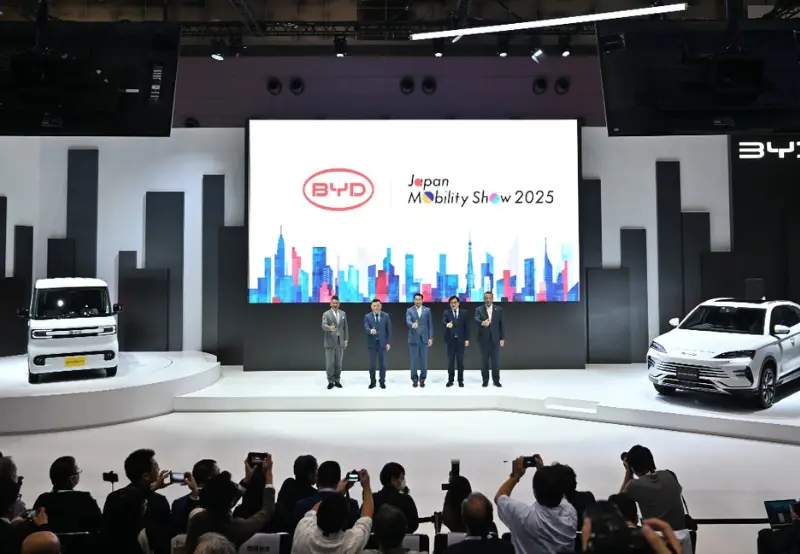

Chinese automaker BYD made waves at the Japan Mobility Show 2025 with the global unveiling of the RACCO K-EV and SEALION 6 DM-i—marking a bold entry into Japan’s EV and hybrid segments.
Introduction
At the Japan Mobility Show 2025 in Tokyo, BYD took centre stage as it marked its official passenger-vehicle debut in Japan with two major launches—the all-electric RACCO K-EV and the plug-in hybrid SEALION 6 DM-i. This move signals BYD’s deeper commitment to Japan’s highly competitive auto market and reflects an ambitious dual strategy of offering both pure-electric (EV) and plug-in-hybrid (PHEV) vehicles.
The Key Models: What’s New?
RACCO K-EV: Designed specifically for Japan, this compact “K-car”-segment electric vehicle reflects BYD’s adaptation to local market needs—urban mobility, compact dimensions and efficient electric power.
SEALION 6 DM-i: Marking BYD’s first plug-in hybrid entry in Japan, this model uses its advanced DM-i “Super Hybrid” powertrain to blend electric propulsion with flexible range for longer trips.
Together, they form the spearhead of BYD’s “EV + PHEV” strategy in Japan, under the event theme “ONE BYD”—which also encompassed its commercial-vehicle portfolio.
Why This Matters for Japan & BYD
- Localisation & Market Strategy: By tailoring the RACCO to the Japanese “kei-car” segment (ultra-compact cars), BYD is entering a niche traditionally dominated by domestic makers—showing willingness to customise rather than export generic models.
- Dual Technology Approach: Some markets still view hybrids as a practical bridge while EV infrastructure catches up. BYD offering both EV and PHEV gives it flexibility and broadened appeal.
- Competitive Landscape: Japan remains one of the most demanding auto markets in the world, with strong domestic brands. BYD’s entries will test its reputation for both quality and product relevance outside its home base in China.
- Commercial & Passenger Synergy: At the event, BYD also displayed its commercial vehicles (buses, trucks) in Japan—indicating that the company sees the entire mobility ecosystem, not just passenger cars.
Implications for Global EV Strategy
- Global Footprint Expansion: BYD’s debut in Japan aligns with many Chinese EV makers’ strategy to expand overseas as domestic competition intensifies.
- Local Preferences Matter: The success of the RACCO K-EV shows that market-specific models may have greater traction than one-size-fits-all exports.
- Hybrid as a Bridge Technology: The SEALION 6 DM-i reinforces the idea that in many regions, consumers may still favour vehicles that combine electric and conventional power rather than fully electric.
- Brand Building Outside China: BYD’s showcase at a major Japanese mobility show helps build its brand image internationally and aligns with its “ocean” (Ocean Series) branding and premium ambitions.
What to Watch Next
- Launch Timeline & Pricing: When will the RACCO and SEALION 6 DM-i arrive in Japan, and at what price point? Competitive pricing will be key.
- Dealer & Service Network: BYD already has a growing presence in Japan’s commercial vehicle space; will its passenger-car network expand rapidly to match?
- Market Reception: Japanese consumers are very quality- and heritage-oriented. BYD will need to deliver with build quality, service reliability and local support.
- Expansion of Model Line-up: BYD has indicated plans to launch seven-eight EV/PHEV models in Japan by 2027.
- Supply Chain & Manufacturing: Will BYD localise production, sourcing or assembly in Japan? That could impact cost and market perception.
Conclusion
The launch of the RACCO K-EV and SEALION 6 DM-i at the Japan Mobility Show positions BYD as a serious global player striving to understand and serve local market dynamics. As BYD enters the Japanese passenger car market in earnest, its ability to compete with entrenched domestic brands will likely hinge on how well it balances innovation, localisation and customer expectations.
For buyers, the entry of BYD brings exciting new choices—compact EVs designed for urban Japan and flexible hybrids for longer journeys. For the auto industry, it underscores that global EV competition is entering a new phase: one where understanding market subtleties and offering both EV and PHEV tech may be key to winning.
For more EV insights, EV News