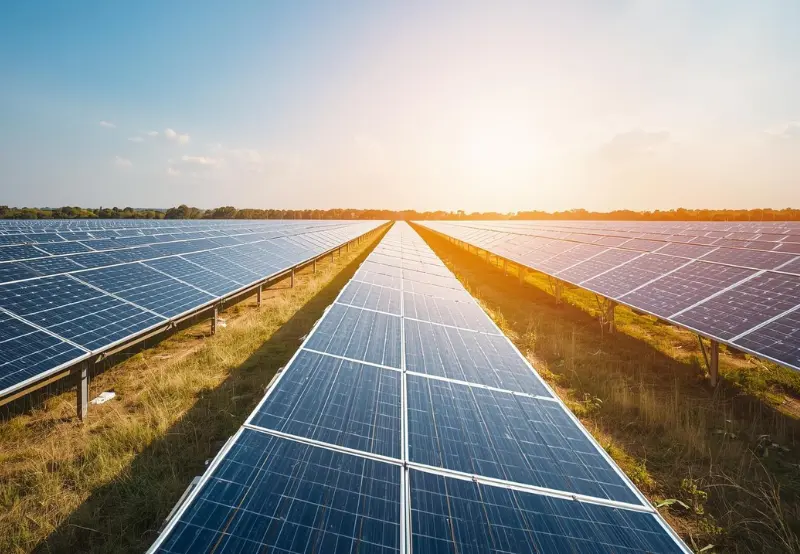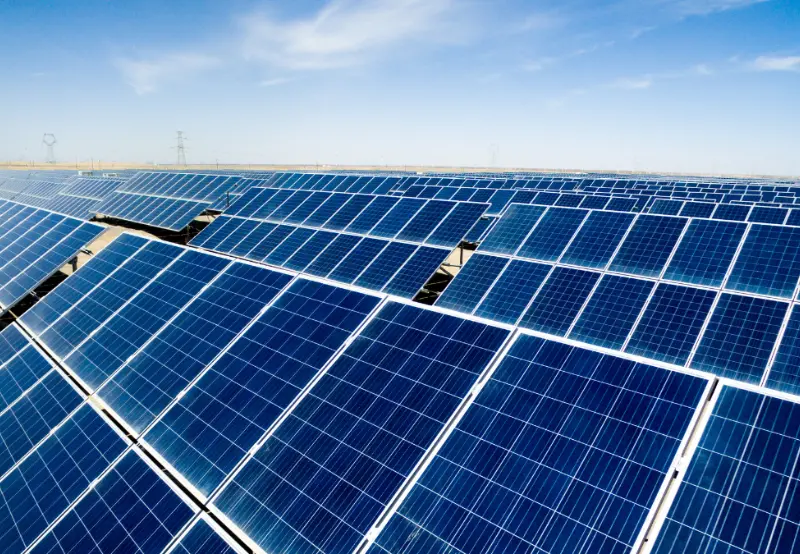

China commissions its first dual-tower solar thermal plant in Guazhou, combining molten-salt storage and enhanced efficiency. Discover how this landmark project reshapes clean energy in deserts.
China dual-tower solar thermal plant: a landmark in desert clean energy
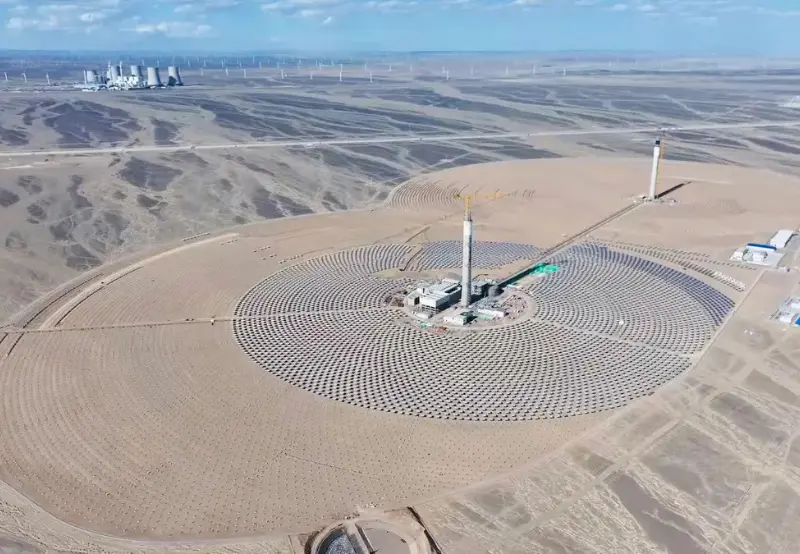
China has officially commissioned a first-of-its-kind dual-tower solar thermal plant in the Gobi Desert, located in Guazhou County, Gansu Province. This cutting-edge facility, built by the China Three Gorges Corporation, employs two 200-metre towers working in tandem to supply a single turbine, marking a breakthrough in solar thermal design.
With 27,000 mirrors (heliostats) focusing sunlight onto the towers, the system captures solar energy during the day, stores thermal energy in molten salts at up to 570 °C, and then drives steam turbines—even after sunset or during cloudy periods.
Operated as part of a larger clean energy hub that includes wind and PV farms, the plant is projected to provide power to about half a million households annually.
But beyond the headline, this project embodies several technical, economic, and strategic lessons for renewable energy globally.
How the dual-tower approach works and why it matters
Morning and afternoon capture
Unlike conventional single-tower plants, the dual-tower configuration divides solar collection across two sites roughly 1 km apart, enabling one tower to dominate in the morning and the other in the afternoon. This staggered collection reduces mirror wastage and improves overall capture efficiency.
Because mirror fields overlap partially, fewer mirrors are needed—significant because mirrors constitute a large share of cost in solar-thermal plants.
Analysts estimate that the dual-tower design improves performance by about 25% over single-tower systems, particularly under variable sun angles.
Molten salt storage and continuous output
One of the core advantages of solar thermal is its ability to store heat—acting like a “thermal battery.” In this plant, molten salts are heated during sunlight hours, then used to produce steam later, providing dispatchable, predictable power even after dark.
This addresses a major limitation of traditional solar PV and wind: intermittency. In a region like the Gobi, where sunlight is abundant but not constant (due to dust, clouds, night), storage is essential to make the power usable.
Strategic context & significance
Complementing PV and wind
China’s strategy has been to aggressively deploy low-cost photovoltaic (PV) and wind farms across its western provinces (Gansu, Xinjiang, Qinghai). But these sources cannot reliably meet demand at night or during lulls. This new solar thermal plant fills that gap, making renewables more reliable and balanced.
Thus, solar thermal becomes not a competitor to PV, but a complementary technology—one that guarantees supply continuity and supports grid stability.
Cost & scale implications
The cost of mirrors, tracking systems, thermal storage, and interconnection remains high. As many experts note, mirrors alone account for nearly 60% of the plant’s overall cost.
However, innovations like dualtower designs reduce mirror requirements and improve efficiency. If replicated at scale, such designs could drive down per-unit costs, making thermal solar more economically competitive.
China has already built 21 commercial solar thermal plants (1.57 GW) and has 30 more under construction (~3.1 GW).
Globally, the Noor Energy 1 plant in the UAE (700 MW) remains one of the largest operating solar thermal complexes. China’s design innovations may position it to lead the next wave of deployment.
Challenges & risk factors
- Capital intensity: Solar thermal plants have high initial CAPEX, especially for large mirror fields and thermal storage systems.
- Technical complexity: Managing two towers, overlapping mirror fields, and storage systems demands precise control and maintenance.
- Dust, sand, and environmental wear: In a desert setting, mirror cleanliness, abrasion, and maintenance become substantial operational burdens.
- Grid integration & transmission: Even a well functioning plant needs robust grid connectivity and management to distribute power effectively.
- Competition from falling PV+battery costs: As solar PV and battery storage continue to drop in price, some pure PV + storage setups may be simpler and cheaper in many contexts.
What this means for India & other nations
For countries like India, with large tracts of sunny land, this dual-tower model offers a promising path for dispatchable solar power. Particularly in arid zones (Rajasthan, Gujarat, Ladakh), solar thermal with storage may help stabilise the grid.
India’s own efforts in solar thermal have been modest and constrained by high costs and risk. But China’s example may inspire renewed investment, innovation, and demonstration projects.
The dual-tower system also shows that design ingenuity matters—not just scale. Redefining layouts, mirror allocations, and thermal storage can yield efficiency gains that shift the economics.
Conclusion
The commissioning of China’s dual-tower solar thermal plant in the Gobi Desert marks a major milestone in clean energy technology. By combining novel engineering with molten salt storage, China has demonstrated a viable path for continuous, dispatchable solar power, even in harsh desert environments.
While challenges—costs, complexity, maintenance—remain significant, this project may well become a blueprint for solar thermal deployment globally. As nations strive to meet net zero and integrate renewables at scale, innovations like this will matter more than ever.
For more Solar News, Visit; Solar News