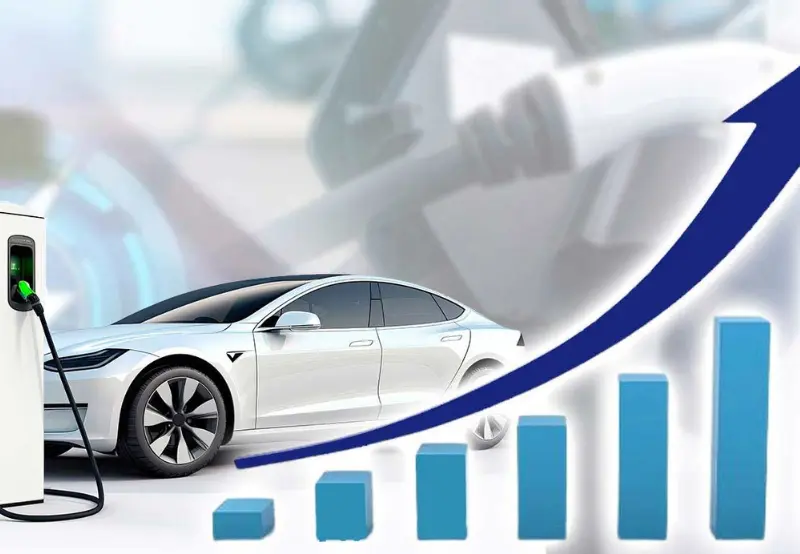

India’s EV battery market is expected to touch USD 27.70 billion by 2028, driven by rising electric vehicle demand, government incentives, and rapid technological innovation.
Introduction
India’s electric vehicle (EV) revolution is charging ahead at full speed. According to recent market research, the Indian EV battery market is projected to reach USD 27.70 billion by 2028, growing at a remarkable pace. The shift toward cleaner mobility, backed by government initiatives, rising fuel costs, and increased environmental awareness, is accelerating the demand for advanced battery technologies across the nation.
The Growth Drivers Behind India’s EV Battery Boom
- Government Policies and Incentives
The Indian government’s strong push towards electrification—through schemes like FAME II (Faster Adoption and Manufacturing of Hybrid and Electric Vehicles) and PLI (Production-Linked Incentive)—has been pivotal in boosting EV adoption. These policies not only encourage EV manufacturing but also promote local battery production, reducing import dependency. - Rising Fuel Prices and Environmental Concerns
With fossil fuel costs soaring and urban pollution levels worsening, consumers are increasingly turning to EVs as a cleaner, more cost-effective alternative. This shift directly fuels the demand for efficient, durable, and affordable batteries. - Technological Advancements
The market is witnessing rapid innovation in lithium-ion batteries, solid-state batteries, and battery-swapping technologies. Indian startups and global companies alike are investing heavily in research and development (R&D) to enhance battery performance, reduce charging time, and increase lifespan.
Market Outlook and Segmentation
The Indian EV battery market’s value of USD 27.70 billion by 2028 reflects exponential growth driven by both two- and three-wheeler EVs, which dominate the domestic landscape.
- Two-Wheelers: Expected to remain the largest segment due to affordability and demand in urban areas.
- Four-Wheelers: Gaining momentum with major automotive brands launching electric variants.
- Energy Storage Systems: Emerging as a parallel market for stationary applications and renewable energy integration.
Moreover, the government’s focus on battery recycling and local cell manufacturing is set to strengthen India’s position as a global EV battery hub.
Key Challenges
While the outlook is optimistic, several challenges persist:
- High Battery Costs: Lithium-ion cells still make EVs relatively expensive for the average buyer.
- Supply Chain Dependence: India currently relies heavily on imports for key raw materials like lithium and cobalt.
- Charging Infrastructure: Expansion of charging networks remains crucial to encourage mass EV adoption.
Efforts are already underway to develop indigenous supply chains, promote battery recycling, and establish gigafactories across the country to meet the surging demand.
The Road Ahead: India’s Green Energy Vision
The journey toward a sustainable transportation ecosystem is just beginning. With a focus on “Make in India” initiatives and global partnerships, the EV battery sector is set to play a defining role in achieving India’s net-zero emission targets by 2070.
Industry experts believe that the period leading up to 2028 will be transformative—turning India into not just one of the world’s largest EV markets but also a key exporter of energy storage technologies.
Conclusion
The forecasted growth of India’s EV battery market to USD 27.70 billion by 2028 marks a monumental shift in the nation’s mobility landscape. As innovation, investment, and policy support align, India is on the path to becoming a global powerhouse in electric mobility and sustainable energy solutions.
The road ahead is electric—and India is leading the charge. ⚡
For more EV News, Visit; EV News