
India’s Standalone Energy Storage Market Poised at a Crucial Turning Point
An April 2025 IEEFA & JMK Research report reveals that standalone energy storage systems (ESS) are now the dominant force in India’s utility-scale energy storage landscape, accounting for 64 % of all tenders—a staggering 6.1 GW in Q1 alone. These independent battery and pumped-hydro installations are reshaping how the grid manages intermittent renewables like solar and wind.
Why Standalone ESS Matters
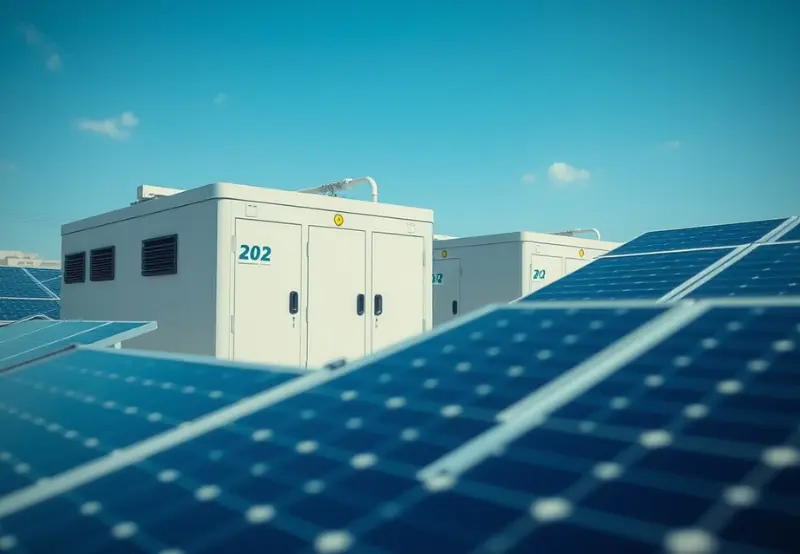
Standalone ESS systems—unlike those tied to solar or wind farms—operate as independent assets, deployed by utilities, grid operators, or third-party providers. Their key roles include:
- Grid balancing and frequency support—rapidly absorbing or discharging energy to stabilise supply.
- Peak shaving—storing power during low-demand periods and discharging during evening peaks, thus reducing expensive procurement.
- Ancillary services such as voltage support, black‑start capability, and congestion relief.
Record-Breaking Tender Activity
India issued 6.1 GW of standalone ESS tenders in early 2025—exceeding the total from all of 2024. This marks a 50-fold surge since 2022, reflecting both policy momentum and investor confidence.
The Policy Boost: VGF
The success of standalone battery ESS has been significantly driven by the Viability Gap Funding (VGF) scheme, offering up to 30 % capital subsidies. This has reduced tariffs by around 40 %—with recent deals in Maharashtra and Rajasthan fetching just ₹219,000–221,000 per MW per month.
Leading Market Players
The tender landscape features both heavyweights and newcomers:
- JSW Energy leads with nearly 2 GW in awarded capacity.
- Established firms like Greenko and Torrent Power are active across battery and pumped hydro segments.
- Newcomers—including Pace Digitek, Oriana Power, Kintech—reflect growing competition.
Key Barriers on the Horizon
Despite the impressive momentum, several obstacles remain:
- Contract delays and cancellations: Approximately 6.4 GW of awarded capacity has already been cancelled due to deferred power purchase agreements (PPAs) amid hopes of falling battery prices.
- Supply‑chain and manufacturing vulnerabilities: Domestic battery cell production is minimal (around 6.7 GWh), and projects depend on imported critical minerals like lithium and cobalt, exposing them to global market swings .
- Financing challenges: Smaller developers struggle with financing due to the nascent nature of the market and lengthy project cycles .
- Execution delays: Pumped hydro projects, while substantial, face spatial and gestation hurdles; battery ESS are more agile but still slow compared to optimal timelines .
The Road Ahead
All signs point to continued growth—but several steps are vital:
- Extend and expand VGF beyond FY2028 and include projects by state DISCOMs to widen participation.
- Clear regulatory bottlenecks and expedite PPA signings to prevent cancellations.
- Boost domestic manufacturing via Production-Linked Incentives (PLI) and critical minerals investment.
- Embrace diverse business models, such as Energy Storage as a Service (ESaaS), to lower entry barriers and stimulate competition.
India’s standalone ESS sector is at a pivotal juncture—no longer a niche, but rapidly evolving into a cornerstone of grid modernisation. With its flexibility, scalability, and grid-balancing capabilities, ESS will be essential in achieving India’s renewable targets (500 GW by 2030) and ensuring a resilient, sustainable power network.
However, triumph depends on addressing execution risks, strengthening local supply chains, and sustaining policy momentum. If these challenges are met, standalone ESS could truly revolutionise India’s energy future.