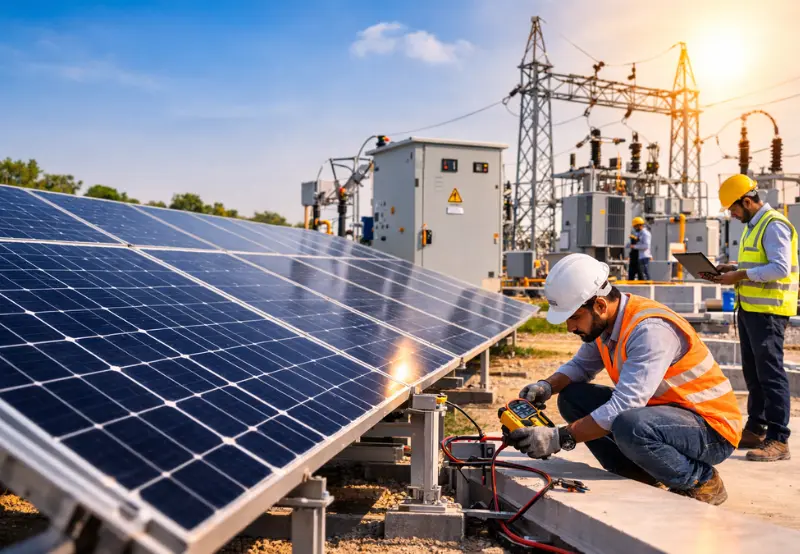
Liquid Air Energy Storage (LAES) offers a clean storage alternative to fossil fuels using ambient air liquefaction. Learn how LAES works, its benefits, and its potential in the global renewable energy transition.
Liquid Air Energy Storage: A Powerful Alternative to Fossil Fuels
As the world accelerates its shift from fossil fuels, storing intermittent renewable energy reliably has become a major hurdle. Now, a nearly 50-year-old idea is being revived: liquid air energy storage (LAES). This technology may not yet be widespread, but it promises to sharpen clean energy grids, smooth supply fluctuations, and reduce reliance on fossil fuels.
1. What is Liquid Air Energy Storage?
Liquid Air Energy Storage (LAES) works by taking in ambient air, compressing it to high pressure, and cooling it until it liquefies. The process involves three main steps:
- Compression and purification: Air is first cleaned and compressed.
- Cooling to liquid form: Using multi-stage cooling (heat exchangers and compressors), air is cooled to around −196 °C, converting it to liquid.
- Storage and regeneration: The liquid air is stored in insulated tanks. When energy is needed, it’s allowed to warm up, expand back into gas, which then drives turbines to generate electricity. Thermal energy recuperated during the compression is reused to improve efficiency.
This cycle produces virtually no emissions — once the initial electricity used (ideally from renewables) and heat recovery systems are accounted for.
2. Why LAES Matters for the Renewable Transition
- Long-duration storage: Unlike lithium-ion batteries that are excellent for short bursts of energy, LAES is suitable for storing power for many hours or even days. This helps cover night times or still days when solar or wind supply drops off.
- Materials and scale advantages: It uses air (abundant and free) and widely used, mature components (compressors, heat exchangers, turbines). No rare earths or lithium are required, making it less vulnerable to resource supply chains.
- Competitive costs: While early LAES plants aren’t yet cheaper than all battery setups, projections suggest that with scale and improvements (especially heat recovery), LAES could be cost-competitive.
3. The First Commercial-Scale Plant and How It Performs
A landmark commercial LAES facility is expected to come online in 2026 in the north-west of England. It’s being developed by Highview Power, and is designed to deliver around 300 megawatt-hours (MWh) of storage — enough to supply tens or hundreds of thousands of homes during peak demand periods.
Initially, LAES systems without heat recovery operate at ~50% round-trip efficiency. With heat recovery systems in place, efficiency improves to over 60%, possibly up to ~70%.
4. Challenges & Trade-offs
LAES is promising, but not without hurdles.
- Efficiency lower than batteries: Lithium-ion batteries can exceed 80-90% efficiency, so LAES must compensate with long-duration capability and lower costs.
- Energy input costs: Cooling to liquid air and compressing air consume energy. If that energy isn’t very cheap or renewable, it undermines the green credentials.
- Infrastructure and insulation: Liquid air must be kept cold and insulated; thermal losses and maintenance are non-trivial.
- Regulatory and market readiness: Grid operators and policymakers must recognise long-duration storage in regulations and planning. It needs investment risk mitigation, appropriate tariffs or incentives.
5. Where LAES Fits in the Clean Energy Ecosystem
LAES is not a replacement for all storage but may well find its niche in several roles:
- Grid balancing: Smoothing supply when renewables oversupply during midday, to be used during low generation times.
- Peaker replacement: Serving as backup or peak demand supply instead of fossil fuel-powered peaker plants.
- Remote or constrained locations: Places where large scale battery plants are less feasible or more expensive.
- Complementing other storage: Hybrid storage systems combining batteries (for fast response) with LAES (for long-duration energy) could offer more resilient systems.
6. Global Potential & Future Outlook
- Plants already under planning include ones in the UK, with proposals in Australia and Japan.
- As renewables (solar and wind) continue to grow, especially in regions with strong intermittent supply, the demand for technologies like LAES will grow.
- Technological improvements — better insulation, more efficient heat recovery, optimised compressors — can further improve performance and reduce costs.
7. Conclusion
Liquid Air Energy Storage offers a powerful, clean alternative to fossil fuels for large-scale, long-duration electricity storage. While its current efficiency is lower than batteries, its strengths lie in scalability, material stability, and ability to store energy across longer periods.
As the world races to decarbonise, LAES may become an essential part of the toolkit — not replacing lithium batteries, but complementing them. With the first commercial plants coming online and improvements under way, liquid air could help deliver the green, reliable grids so many countries need.
For more news, Visit, Energy Storage