India’s battery storage industry is poised for explosive growth and a recent high-profile meeting could be a catalyst. Gautam Adani’s visit to CATL’s headquarters signals a potential strategic alliance between the Adani Group and the world’s leading lithium-ion battery maker.
Why This Pact Matters
1. CATL’s Global Dominance
Contemporary Amperex Technology Co. Ltd. (CATL) is not just another name in batteries, it produces over a third of the world’s EV batteries, supplying giants like Tesla, BMW and Volkswagen. It also leads in cell chemistry diversity, advancing both nickel-rich NMC and cobalt-free LFP chemistries excellent for thermal resilience and cost reduction and developing sodium-ion batteries, which bypass India’s lithium scarcity.
2. India’s Policy Winds
India’s Finance Bill recently eliminated import duties on machinery for lithium-ion battery production, lowering barriers for domestic gigafactories. Further incentives such as the PLI (Production Linked Incentive) scheme encourage local advanced battery manufacturing.
🚀 Potential Impacts: Industry Estimated Benefits
| Sector | Potential Benefit |
| Stationary Storage | Massive gigafactories using CATL’s LFP cells could support grid-level storage, enabling solar and wind integration and smoothing demand peaks. |
| Electric Mobility | Building cells locally means cheaper, home-grown EV batteries crucial as India’s EV production grew ~22% in 2024 (~125,500 units). Adani’s EV-charging + gas-station network could then vertically integrate with in-house batteries. | |
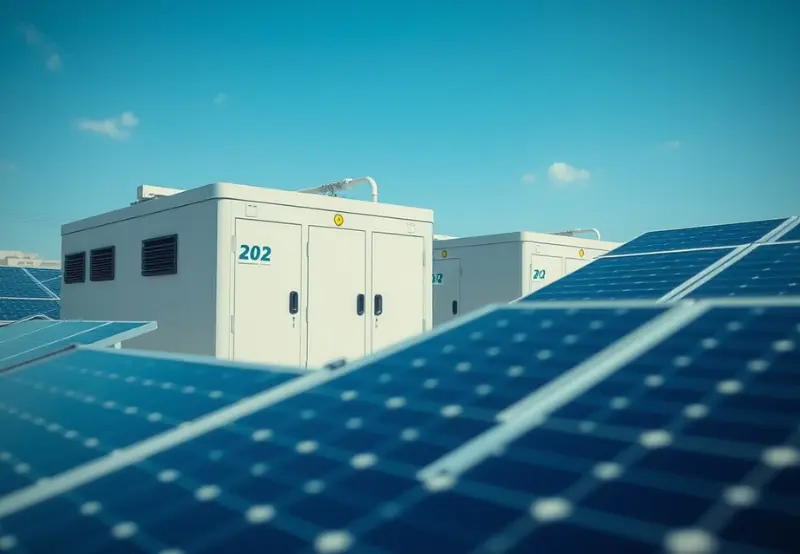
| Industrial Grid Backup | With CATL’s containerised ESS products like TENER 6.25 MWh units, Adani could offer “plug-and-play” systems to hospitals, data centres and telecom towers. |
| Clean-Energy Expansion | Adani’s ambitious target of 50 GW renewables by 2030 will require tens of GWh of storage—linking up with CATL provides both supply and technological leverage. |
🧠 A Win-Win for Adani And CATL
- Technology Transfer: Adani could leverage CATL’s tech and production know-how, replicating its rapid scale-up in Germany and Hungary for the European EV market.
- Mitigated Regulatory Risk: A local partner helps CATL navigate India’s cautious stance on direct Chinese investment, while the government benefits via localisation and job creation.
- Priority Access: As global battery demand tightens, this collaboration ensures Adani first dibs on equipment and cells securing supply for its diverse energy footprint.
📈 What Comes Next?
- Gigafactory Setup: A joint venture could see CATL’s lithium-ion or sodium-ion cells produced at scale in India, decentralising supply and reducing costs.
- Supply for Adani’s Ecosystem: Including solar PV, wind farms, EV fleets, battery swapping services and charging stations.
- Broader Industry Uplift: Competition from giants like Adani–CATL could catalyse growth across mineral refining, component manufacturing, recycling and speed India’s rise as both consumer and exporter.
🌐 The Big Picture
Indian policy and Adani’s visit suggest that a serious battery play is in motion. If it materialises, the synergies between Adani’s infrastructure might and CATL’s technological edge could set India on a fast track to not just grid parity, but global leadership in clean energy and battery exports. While deal specifics remain to surface, this marks a pivotal moment in the nation’s transition to green power and electrification.
A Adani–CATL pact stands to be a landmark in India’s green-tech journey. Together, they could forge a new national battery industry, fuel EV take-up, anchor renewable projects, and empower industrial resilience, ushering in a truly integrated clean energy future.