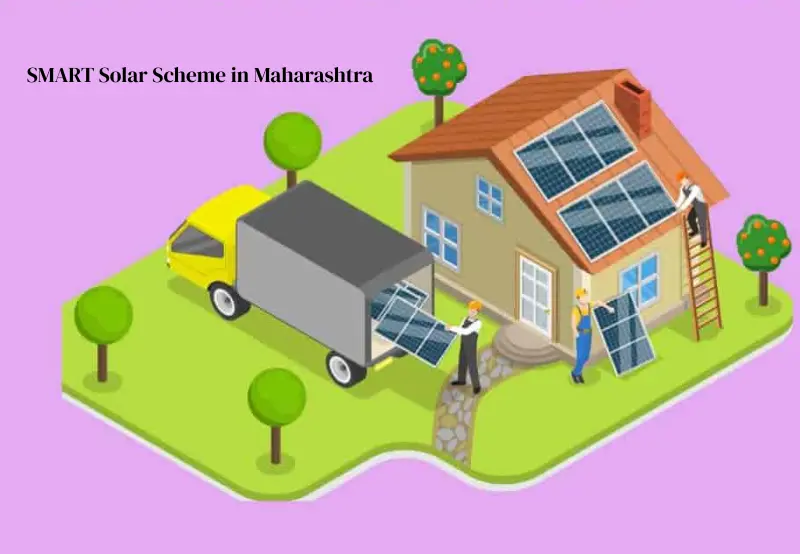

SMART Solar Scheme in Maharashtra helps low-income households install rooftop solar. Discover 3 game-changing subsidies under this scheme and how it empowers self-reliant clean energy in the state.
SMART Solar Scheme in Maharashtra: Transforming Rooftops for Low-Income Households
SMART Solar Scheme Maharashtra is the state’s new push to bring rooftop solar within reach of low-income families. Under the Swayampoorna Maharashtra Residential Rooftop (SMART) plan, the government will provide enhanced state subsidies on top of central support to households using less than 100 units of electricity per month—especially those below the poverty line (BPL) and economically weaker sections.
Around five lakh households are set to benefit, with support tailored for BPL, SC, ST and EWS categories. The scheme aims not only to reduce electricity bills to near zero, but also to enable surplus power sales back to the grid.
1. How the SMART Solar Scheme Works
- The scheme is designed for domestic consumers whose electricity consumption is under 100 units per month, especially low-income groups.
- It supplements the central government’s rooftop solar subsidy (under PM Surya Ghar Muft Bijli Yojana) with an extra state subsidy to reduce the upfront cost further.
- Installations will use “Made in India” IEC-certified solar modules; the state DISCOM (MSEDCL) will manage procurement, installation and maintenance.
- Surplus power generated can be fed back into the grid, giving households a chance to earn additional income.
2. Subsidy Details & Financial Structure
The scheme sets a benchmark cost of ₹50,000 per kW. Depending on the category:
| Category | Household Contribution | State Subsidy | Central Subsidy | Effective Subsidy % |
|---|---|---|---|---|
| BPL | ₹2,500 | ₹17,500 | ₹30,000 | ~95% subsidised |
| Economically Weaker (General) | ₹10,000 | ₹10,000 | ₹30,000 | ~80% subsidised |
| SC / ST | ₹5,000 | ₹15,000 | ₹30,000 | ~90% subsidised |
This structure drastically cuts down the upfront burden for eligible households.
3. Targets, Timeline & Implementation
- The scheme is envisaged to run until March 2027.
- A budget of ₹655 crore is allocated for FY 2025–26 and FY 2026–27.
- The state targets 5 lakh households, split among BPL, EWS, SC/ST consumers.
- In underdeveloped or remote districts like Melghat, Gadchiroli, Chandrapur, priority will be given to rollout.
- MSEDCL will issue tenders for vendors, ensure standard compliance, and conduct quarterly oversight.
4. Significance for Low-Income Households
- The scheme enables energy self-reliance: households that often struggle with high electricity costs can reduce or eliminate bills.
- Because many of these households have minimal existing power consumption, bringing them onto solar can be transformative financially.
- Selling surplus solar power offers a modest revenue stream, increasing the economic value of their rooftop.
- It also extends clean energy benefits to vulnerable populations, helping reduce inequality in access to power.
5. Challenges & Risks
- Awareness & Adoption: Many eligible households may not know about the scheme or may be sceptical of technology and costs.
- Upfront Mobilisation: Even minimal contributions (₹2,500 etc.) can be a hurdle for poorest families unless support/facilitation is strong.
- Technical & Quality Control: Ensuring all installations meet safety, durability, and efficiency standards is critical.
- Grid Integration & Net Metering: DISCOMs must handle net metering, billing and feeding surplus power reliably.
- Maintenance & Longevity: After installation, households will need support to maintain panels, inverters, and ensure uptime.
- Disparities in Roof Suitability: Not every home’s roof (shade, structure, orientation) is ideal for solar installation — this may limit uptake in certain areas.
6. Interplay with National Rooftop Solar Schemes
The SMART Solar Scheme aligns closely with central programmes like PM Surya Ghar Muft Bijli Yojana, which seeks to install rooftop solar in up to 1 crore households by 2026–27.
By layering state subsidy over central support, Maharashtra is enhancing affordability and access, especially for households that might otherwise still be priced out.
Successful rollout in Maharashtra can serve as a blueprint for other states to adopt “top-up subsidy + central scheme synergy” models.
7. What to Watch & Next Steps
- Early Adoption Metrics: Which districts or consumer segments lead uptake?
- Operational Efficiency: How well will MSEDCL manage installation, verification and service?
- Grid & Billing Systems: Effectiveness of net metering, surplus energy settlement, and system balance.
- Extension or Scaling: Will the scheme expand beyond 2027 or be scaled to higher-use categories?
- Replication by Other States: This may set a precedent for state-level solar subsidy innovations across India.
Conclusion
The SMART Solar Scheme Maharashtra is a bold and inclusive step toward democratizing rooftop solar. By targeting low-income households and layering state subsidy over central support, the state is enabling real access to clean energy. The success of this scheme could become a model for other states, helping India’s renewable ambitions become more equitable and widespread.
By reaching those at the base of the pyramid, Maharashtra is not just growing solar capacity — it’s empowering citizens, reducing energy inequality, and making clean power a tool for social upliftment.
For more SOLAR NEWS, visit; Solar News