
The South Korea Offshore Wind Auction marks a major milestone with 689 MW of clean energy commitments, boosting renewable power and investor confidence in Asia.
Introduction
The South Korea Offshore Wind Auction has emerged as a defining moment for Asia’s renewable energy journey. With 689 megawatts (MW) of offshore wind commitments successfully secured, the country is making strides towards its ambitious goal of achieving 14.3 gigawatts (GW) of offshore wind capacity by 2030.
The success of this auction demonstrates growing investor confidence, stronger policy backing, and South Korea’s rising influence in the global offshore wind sector. As governments across Asia accelerate the clean energy transition, South Korea’s model highlights the value of competitive bidding, robust policy frameworks, and private–public collaboration.
Table of Contents
- Overview of the South Korea Offshore Wind Auction
- Details of the 689 MW Capacity Allocation
- Offshore Wind Power in South Korea’s Energy Strategy
- Investor Confidence and Global Participation
- Technology, Ports, and Supply Chain Preparedness
- Environmental and Economic Impact
- South Korea’s 2030 Offshore Wind Targets
- Comparisons with Global Offshore Wind Leaders
- Challenges and Policy Solutions
- Conclusion: A Blueprint for Asia’s Clean Energy Future
1. Overview of the South Korea Offshore Wind Auction
South Korea has successfully concluded its latest offshore wind auction, securing 689 MW of new clean power commitments. Conducted by the Ministry of Trade, Industry and Energy (MOTIE), this auction signals a turning point in the nation’s renewable energy ambitions, making South Korea a leading Asian hub for offshore wind technology.
This auction attracted global investors and developers, showing that South Korea’s regulatory reforms and incentives are creating a favourable investment climate for renewable infrastructure.
2. Details of the 689 MW Capacity Allocation
The awarded projects in this auction are expected to be distributed across multiple offshore sites along South Korea’s western and southern coastlines.
- Installed Capacity: 689 MW
- Expected COD: 2027–2028
- Participating Developers: A mix of domestic players like SK E&S and Korea Electric Power Corp (KEPCO), along with international offshore wind giants.
- Auction Mechanism: A competitive auction with fixed-price incentives to ensure price transparency.
The projects will add significant renewable capacity to South Korea’s grid, reducing reliance on imported fossil fuels and improving grid stability.
3. Offshore Wind Power in South Korea’s Energy Strategy
South Korea’s 2050 Net Zero Roadmap prioritises offshore wind as a cornerstone of decarbonisation. With limited land availability for large-scale solar and onshore wind, offshore wind is key to achieving 21.6% renewable energy share by 2030.
The country aims to leverage its coastal geography, shipbuilding expertise, and advanced engineering to become an offshore wind leader in Asia.
4. Investor Confidence and Global Participation
This successful auction reflects growing international confidence in South Korea’s renewable energy market. Foreign investors see South Korea as a stable entry point into Asia’s booming energy sector, especially as governments across the region increase incentives for clean energy.
Investors are attracted by:
- Transparent auction design
- Stable feed-in tariffs
- Strong engineering workforce
- Partnerships with global leaders like Ørsted, Equinor, and Vestas
5. Technology, Ports, and Supply Chain Preparedness
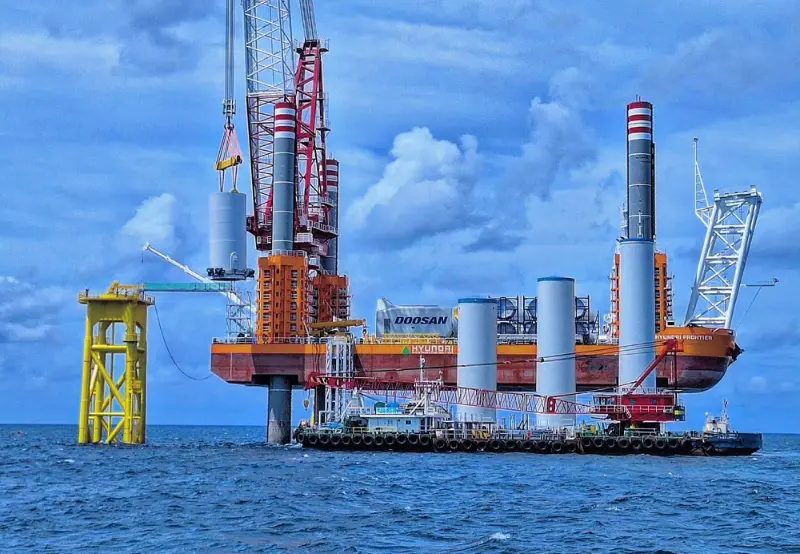
South Korea’s shipbuilding industry is uniquely positioned to support offshore wind. Companies like Hyundai Heavy Industries are producing floating platforms and turbine parts, creating a fully integrated supply chain.
Investments in port infrastructure are also ramping up to support heavy-lift vessels, turbine assembly, and logistics hubs, especially in cities like Ulsan and Mokpo.
6. Environmental and Economic Impact
The 689 MW of offshore wind will:
- Offset 1.5 million tonnes of CO₂ annually
- Power 700,000 homes
- Generate thousands of skilled jobs in engineering and construction
- Boost regional economies through infrastructure development
By reducing its dependency on fossil fuel imports, South Korea strengthens its energy security and contributes to global climate goals.
7. South Korea’s 2030 Offshore Wind Targets
South Korea has committed to 14.3 GW of offshore wind capacity by 2030. This latest auction brings the nation closer to this milestone, with upcoming auctions expected to unlock an additional 4 GW of capacity by 2026.
These projects align with Asia’s growing offshore wind market, where Japan, Taiwan, and Vietnam are also scaling deployment.
8. Comparisons with Global Offshore Wind Leaders
South Korea’s progress mirrors trends in Europe and the US, where competitive auctions have driven costs down significantly:
- UK’s Hornsea projects showcase economies of scale
- Denmark and the Netherlands lead in offshore grid planning
- US is building its East Coast supply chain
By adopting global best practices, South Korea is emerging as Asia’s offshore wind powerhouse.
9. Challenges and Policy Solutions
Despite its success, South Korea faces hurdles:
- Lengthy permitting processes
- Local opposition (NIMBY concerns)
- Environmental impact assessments
MOTIE is addressing these with streamlined regulations, community engagement incentives, and stronger environmental standards to ensure responsible deployment.
10. Conclusion: A Blueprint for Asia’s Clean Energy Future
The South Korea Offshore Wind Auction is more than a milestone—it’s a blueprint for energy transformation in Asia. By securing 689 MW of clean power commitments, South Korea proves that transparent auctions, strong infrastructure, and global partnerships are key to scaling offshore wind.
As the world races to meet net-zero targets, South Korea’s model showcases how nations can build resilient, low-carbon power systems, while creating jobs and boosting local economies.
Related Read:https://ecodigest.in/reliance-infra-wins-390-mw-solar/