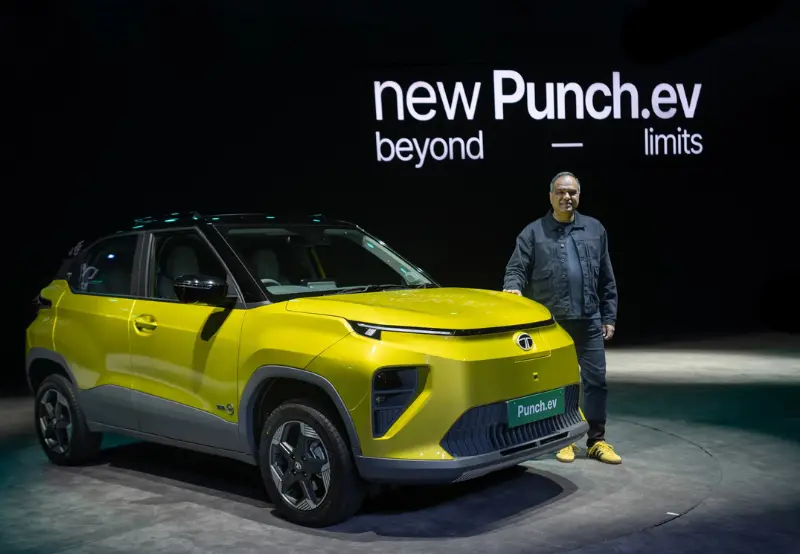

India’s leading automotive manufacturer, Tata Motors, is stepping up efforts to make electric vehicles (EVs mainstream with the launch of its affordable and fast-charging Punch EV. The company says this new compact EV is designed specifically to attract buyers in the entry-level segment, a key market category that could unlock widespread EV adoption across India’s large and price-sensitive car market.
A Budget-Friendly EV for Everyday Use
The Punch EV is priced from around $10,650 (approximately ₹9–10 lakh), making it one of the most competitively priced electric cars available in India’s EV landscape. A long-range variant capable of travelling up to 350 kilometres on a single charge is also offered at about $13,850.
To further reduce the upfront cost, Tata Motors provides an option to decouple the vehicle price from the battery cost. Under this arrangement, buyers can purchase the car for as low as $7,100 and then pay for battery usage separately at a rate of about 3 cents per kilometre — an approach intended to make electric mobility more accessible for a wider range of consumers.
Fast Charging and Practical Range
A major highlight of the Punch EV is its fast-charging capability, which enables the battery to charge from around 20 per cent to 80 per cent in approximately 26 minutes using a DC fast charger. This significantly reduces charging downtime and addresses a common concern among potential EV buyers regarding range and charging convenience.
In addition, most new versions of the model come with a lifetime warranty on the battery, offering peace of mind for buyers worried about long-term battery performance.
Addressing Key Barriers to EV Adoption
Tata Motors’ strategy focuses on breaking through longstanding barriers in the EV market — chiefly affordability, range anxiety and charging infrastructure. Despite India’s rapid economic growth and increasing demand for personal mobility, EV adoption has lagged in the entry price segment. In this category, which accounts for roughly 65 per cent of the cars sold annually, electric vehicle sales represent a small fraction of total sales.
CEO Shailesh Chandra has acknowledged that gaining traction in this segment is essential to mainstream EV adoption, pointing out that EVs currently capture only a small percentage of sales in sub-₹12 lakh models. As a result, the Punch EV has been deliberately positioned to bridge this gap by delivering practicality and cost savings without sacrificing performance.
Supporting National EV Goals
India’s national EV policy aims to grow EV sales to approximately 30 per cent of the total car market by 2030, up from around 5 per cent today. This shift is part of broader objectives to reduce reliance on imported fuels, cut urban air pollution and support climate action.
However, overall EV sales growth has shown signs of slowing, prompting manufacturers like Tata Motors to innovate with pricing, product features and marketing strategies to stimulate demand. Lower prices, better charging performance and flexible ownership models are all part of initiatives aimed at making electric vehicles more appealing and affordable for average buyers.
Competition and Industry Context
Tata Motors is not alone in targeting this emerging market segment. Competitors including MG Motor, Mahindra & Mahindra and newcomers such as Maruti Suzuki — which has recently introduced its first electric SUV — are pressing to establish their positions in India’s growing EV space.
By sacrificing short-term profit margins and focusing on long-term adoption, Tata Motors is betting that affordable EVs with strong performance and fast-charging capability will help shift consumer preferences and accelerate electrification of India’s automotive market.